Tr.1
«Broken Dreams»
Produced by Kruse, Kohler, Tramp for Coconut / A La Carte Music
Commerz Musikverlag / Ariola Eurodisc, GmbH., 1985
602 092-213
Tr.2
«Rackety Ride» Produced by Christoph Leis-Bendorff for K.B.C.
Recorded and Mixed at «Tonstudio Am Walde» / B. Mikulski Publ.
ZYX Records, 1987
5662
Tr.3
«A Cry in the Night»
Produced by Dieter Bohlen / Co-Producer: Luis Rodriguez
WEA Music, GmbH., Neue Medien und Elektronikvertrieb, 1989
246 881-0
Tr.4
«Maxi-Single 45 RPM»
Produced by M. Menichelli and Bobby to for Intersong
Teldec Schallplatten, GmbH. / Intersong, 1986
6.20536
Tr.5
«Shot in the Night» Produced by Gerke & Hannes
Gerke/Hannes, 1985
1CK 060 20 0662 6
Single: 1C 006 2006617
Tr.6
«Maxi-Single 45t.» Hanseatic M.V.
Produced by Dieter Bohlen / Co-Producer: Luis Rodriguez
HANSA / BMG Ariola Munchen, GmbH., 1990
613 185
Tr.7
«Eighth Wonder — I’m Not Scared — Maxi Single»
10 Music, Ltd. / Cage Music, Ltd. / Produced by Pet Shop Boys and Phil Harding
CBS Records, Inc., 1988
CBS 651 359 6
Tr.8
«Shot in the Night» Produced by Gerke & Hannes
Gerke/Hannes, 1985
1CK 060 20 0662 6
Single: 1C 006 2006617
Tr.9
«For Your Love» Produced by A.Martin for Coconut
A La Carte / Ariola Group of Companies / Coconut Records, GmbH., 1985
601 955
TTP: 44:08 min.
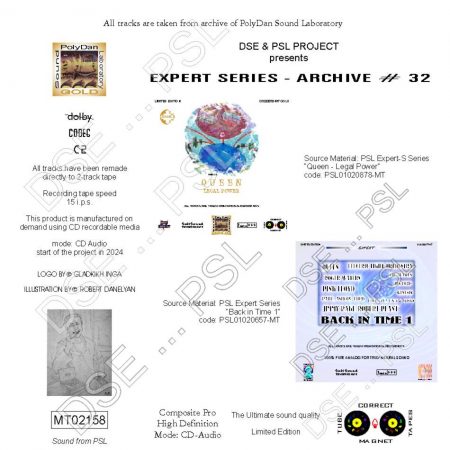
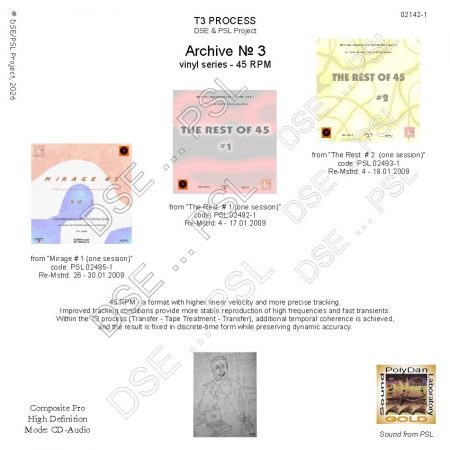
Tr. 1 — 4 from «Mirage 45 — # 1 — Instrumental Collection (one session)» code: 02495-1; date: 26 — 30.01.2009
Tr. 5 & 6 from «The Rest of 45 — # 1 (one session)» code: 02492-1; date: 4 — 17.01.2009
Tr. 7 — 9 from «The Rest of 45 — # 2 (one session)» code: 02493-1; date: 4 — 18.01.2009
T3 Process
Three stages — one result
Why this process is compelling
It gives access to material absent from the digital domain — some vinyl records were never reissued.
The essence is not the transfer, but the sound work.
Maximum information is extracted from the groove: microdynamics are refined, time structure is stabilized, and medium and chain artifacts are reduced.
The result is a master that preserves the original character, yet is more precise and informative.
Fixation in CD-DA is a stable, controlled form.
This is not digitization — it is reconstruction and fixation of sound in its most readable state.
Who this may appeal to
— those seeking rare material absent from the digital domain
— those who perceive differences in microdynamics and timing
— those who value accuracy over format convenience
— those who believe vinyl and tape are incompatible with digital media
How it is achieved
Accuracy starts with mechanics: stable reading with minimal correction.
The key stage — Tape Treatment:
— a tape machine with correction, where timing is structured, microdynamics are formed, and signal integrity is refined.
The principle is not to «enhance», but to remove what prevents the original from being heard.
Final stage — fixation:
— clean, linear capture in CD-DA without repeated conversions
Why it is audible
Audibility comes not from addition, but from alignment.
When timing is stabilized, microdynamics are refined, and artifacts are reduced, the sound ceases to fragment and is perceived as a coherent structure.
In this state, detail, space, and natural articulation become apparent without effortful listening.
Coda:
This is perceived as ease of listening, the sound fully раскрывается (fully reveals itself), yet never becomes fatiguing, remaining coherent and whole.
© DSE/PSL Project, 2026
45 RPM — a format with higher linear velocity and more precise tracking.
Improved tracking conditions provide more stable reproduction of high frequencies and fast transients.
Within the T3 process (Transfer — Tape Treatment — Transfer), additional temporal coherence is achieved,
and the result is fixed in discrete-time form while preserving dynamic accuracy