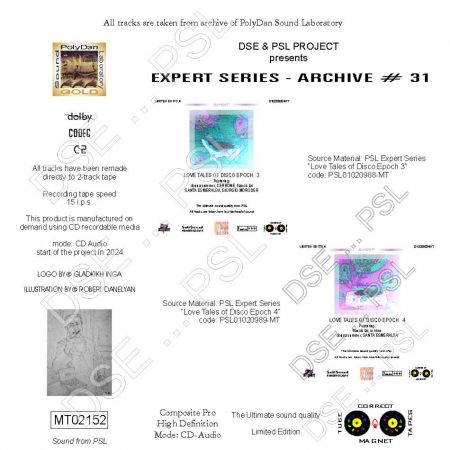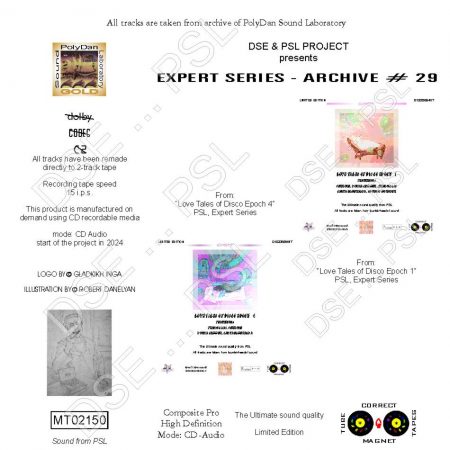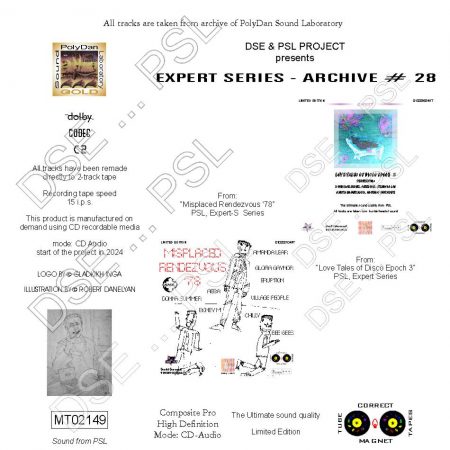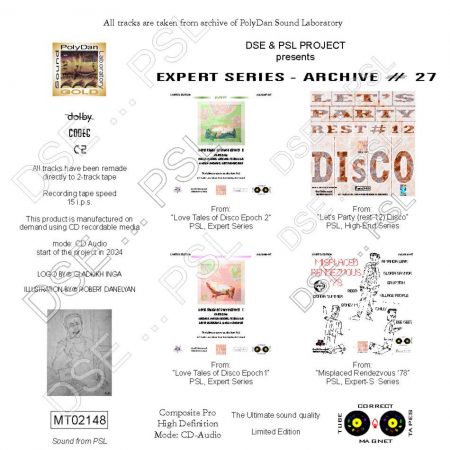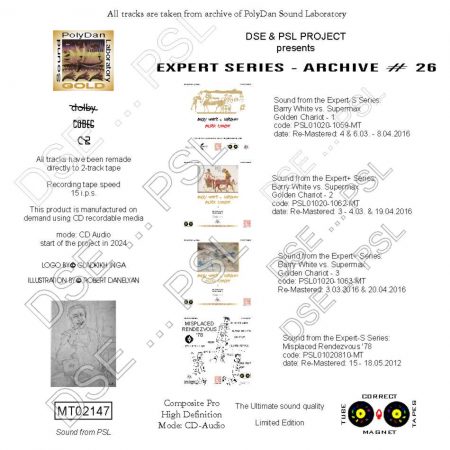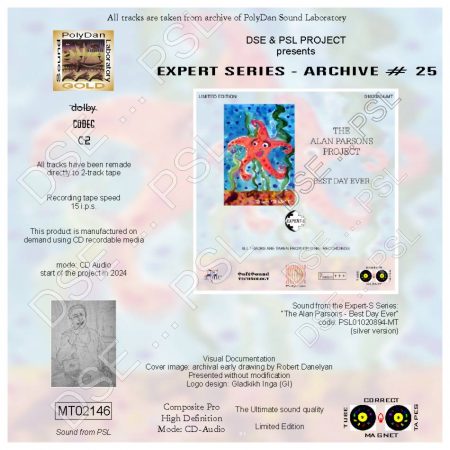
Tr.1
ALEC R. COSTANDINOS
Café America, Inc. (O. P. Fefee Music), ASCAP
Produced by Alec R. Costandinos
Casablanca Record & Filmworks, Inc., U.S.A., 1978
NBLP7124DJ
Tr.2
CERRONE
Sacem Cerrone Music / A Cerrone Production
Produced by Cerrone
Original Sound Track “Brigade Mondaine”
Recorded 78 at Trident Studios, Ferber Studios
Malligator, 1978
773.805
Tr.3
FRANCIS LAI — Original Motion Picture — Soundtrack of the Film “Bilitis”
A Film by David Hamilton
United Artists Music, Ltd.
Productions by Pinepoint, Ltd.
Music by Francis Lai
Produced and Published by Editions 23
Editions Marouani
United Artists Records, Ltd., 1978
UAS 30161
Tr.4
GIORGIO
Rick’s Music, Inc. (BMI) / Sunday Music / OASIS
*Tro-Essex Music, Inc. (ASCAP)
*Accompanied by The Munich Machine
Produced by Giorgio Moroder
Recorded at Musicland Studios, Munich, April 1976
Casablanca Records, Inc., Los Angeles, California, 1976
OCLP 5006
TTP: 41:09 min.
Tr. 1
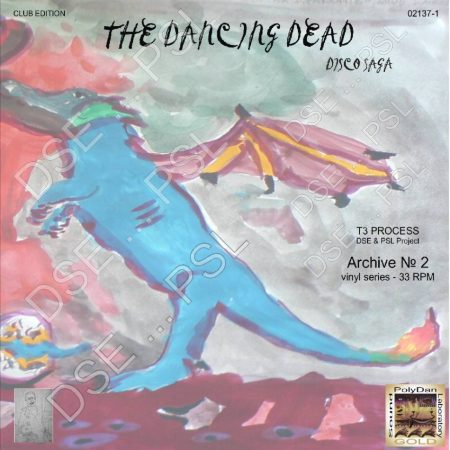
from «The Dancing Dead — part 1 (one session)» code: 020805-1; date: 6.05.2012
Tr. 2 — 4
from «The Dancing Dead — part 2 (one session)» code: 020805-1; date: 7.05.2012
T3 Process, Reproduction & Compilation: code: 02137-1; date: 25.03.2026
T3 Process
Three stages — one result
Why this process is compelling
It gives access to material absent from the digital domain — some vinyl records were never reissued.
The essence is not the transfer, but the sound work.
Maximum information is extracted from the groove: microdynamics are refined, time structure is stabilized, and medium and chain artifacts are reduced.
The result is a master that preserves the original character, yet is more precise and informative.
Fixation in CD-DA is a stable, controlled form.
This is not digitization — it is reconstruction and fixation of sound in its most readable state.
Who this may appeal to
— those seeking rare material absent from the digital domain
— those who perceive differences in microdynamics and timing
— those who value accuracy over format convenience
— those who believe vinyl and tape are incompatible with digital media
How it is achieved
Accuracy starts with mechanics: stable reading with minimal correction.
The key stage — Tape Treatment:
— a tape machine with correction, where timing is structured, microdynamics are formed, and signal integrity is refined.
The principle is not to «enhance», but to remove what prevents the original from being heard.
Final stage — fixation:
— clean, linear capture in CD-DA without repeated conversions
Why it is audible
Audibility comes not from addition, but from alignment.
When timing is stabilized, microdynamics are refined, and artifacts are reduced, the sound ceases to fragment and is perceived as a coherent structure.
In this state, detail, space, and natural articulation become apparent without effortful listening.
Coda:
This is perceived as ease of listening, the sound fully раскрывается (fully reveals itself), yet never becomes fatiguing, remaining coherent and whole.
© DSE/PSL Project, 2026
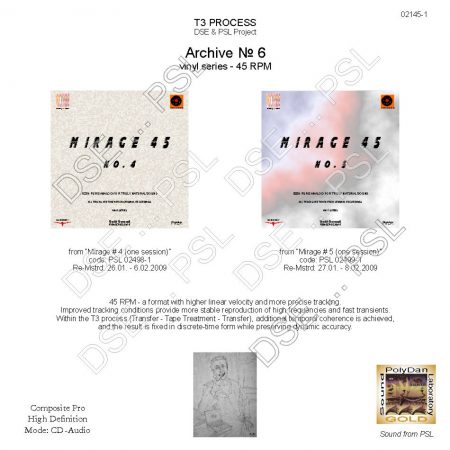
33 RPM — a standard for extended playback with high groove density.
At lower linear velocity, the playback mechanics operate near their precision limits, affecting fast transients and microdynamics.
Within the T3 process (Transfer • Tape Treatment • Transfer), the signal’s time structure is reassembled and stabilized, then fixed in digital form without further loss.